
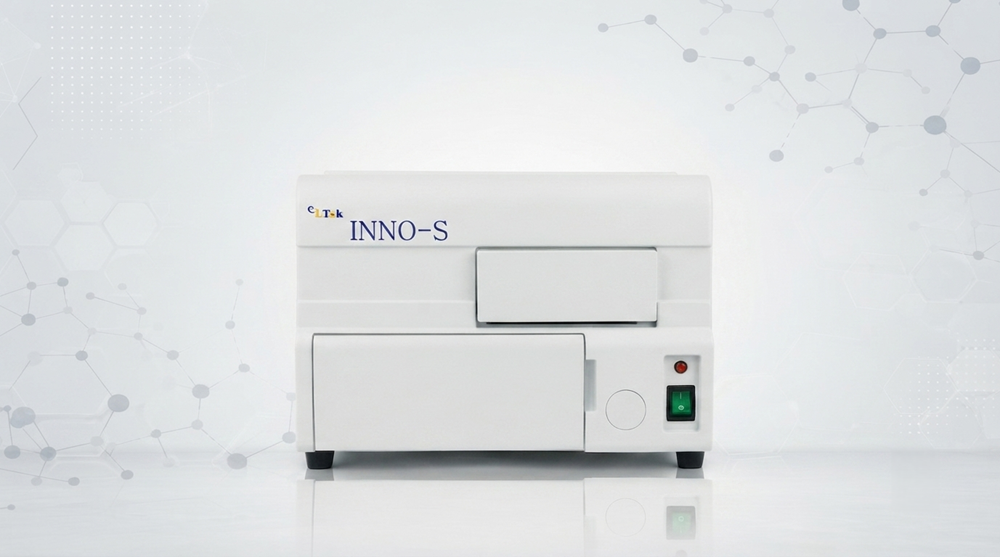
LTek INNO-S Microplate Reader
The LTek INNO-S Microplate Reader is a high-performance benchtop ELISA reader designed for accurate absorbance, luminescence, and fluorescence measurements. It is widely used in hospitals, diagnostic laboratories, pharmaceutical industries, research institutes, and biotechnology laboratories for reliable immunoassay and life science applications.
Featuring semi-automatic operation, multiple detection modes, and RS-232/LAN connectivity, the INNO-S delivers fast, precise, and repeatable results. Its compact design, intuitive operation, and compliance with CE and RoHS standards make it an excellent solution for routine laboratory testing and research.
Product Specifications
| Product Name | INNO-S Microplate Reader |
|---|---|
| Brand | LTek |
| Model | INNO-S |
| Reader Type | ELISA Reader |
| Instrument Type | Benchtop |
| Automation | Semi Automatic |
| Detection Modes | Absorbance, Luminescence & Fluorescence |
| Interface | RS-232, LAN |
| Power Consumption | 90 W |
| Usage/Application | Hospital & Laboratory |
| Compliance | CE & RoHS Certified |
| Packaging | Box |
Key Features
- High-performance ELISA microplate reader for laboratory diagnostics
- Supports absorbance, luminescence, and fluorescence detection
- Semi-automatic operation for accurate and repeatable measurements
- RS-232 and LAN connectivity for seamless data transfer
- Compact benchtop design with low power consumption
- CE and RoHS compliant for safe and reliable laboratory operation
Applications
The LTek INNO-S Microplate Reader is widely used in hospitals, diagnostic laboratories, pharmaceutical industries, biotechnology laboratories, research institutes, universities, and clinical laboratories for ELISA testing, immunoassays, protein analysis, enzyme kinetics, drug discovery, and other life science applications.
Working Principle
The INNO-S Microplate Reader measures the interaction of light with samples contained in microplate wells. Depending on the selected mode, it detects absorbance, fluorescence, or luminescence signals and converts them into quantitative data. The processed results enable accurate analysis of biological, biochemical, and clinical samples for diagnostic and research purposes.